The royal game
The Royal GameThe royal game is the narrator’s name for chess, but the phrase gathers meanings that the story keeps in tension: chess is at once an intellectual art, a way to impose order on emptiness, and a practice that can become perilously consuming. Dr B’s account gives that tension its sharpest form. A book of 150 grandmaster matches helps him withstand isolation by turning chess into an inward world; later, his return to a real board makes that refuge a source of fear as well as fascination.
Chess as an Intellectual Art
Reflecting on Mirko Czentovic’s guardedness, the narrator considers the kind of mind that can devote itself to chess. He resists treating it as merely a game: its fixed board and rules contain seemingly endless possibilities, and its practice combines calculation with imagination. Chess appears to stand between science and art, mechanical in structure yet dependent on the player’s capacity to envision what may follow. Its narrow, unchanging field can produce a distinct form of mastery, in which vision, patience, and technique work together.
The narrator’s description also establishes a contrast that becomes important to Dr B’s story. Chess can be learned by anyone, yet mastery requires an unusual concentration of abilities. The game’s apparent limits make it suited to intense mental activity, but the same demands that sharpen thought can also draw a player into a world increasingly detached from ordinary life.
Isolation and the Chess Almanac
Dr B explains that the authorities placed him in a room of his own at the Hotel Metropole, the Gestapo headquarters. The apparent comfort of a bed, armchair, washbasin, and barred window concealed a method of interrogation based on isolation. The door remained locked, the window faced a firewall, and he had no books, writing materials, watch, or access to ordinary conversation. A warder was present but forbidden to speak or answer questions. With the ordinary signs of time, company, and occupation removed, Dr B was left alone with a few mute objects and his own thoughts.
During this confinement, he secretly obtained a book and carried it back to his room. He first imagined that it might be a demanding literary work, but discovered instead that it was a chess almanac containing 150 grandmaster matches. The book offered no conventional reading: its pages consisted of match diagrams and notation that he initially could not understand. With no board or pieces, he had to make the records usable through whatever materials his circumstances allowed.
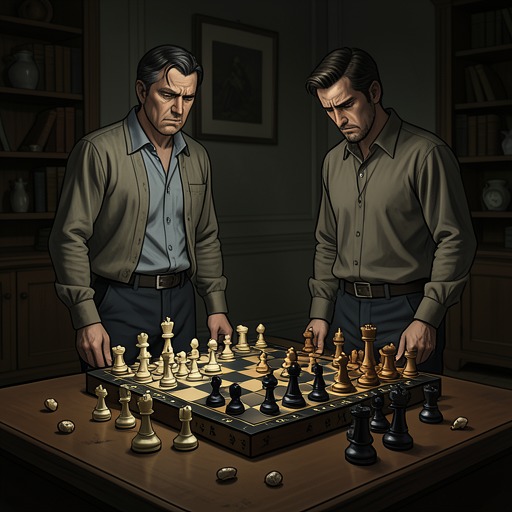
Dr B learned that the letters and numbers identified squares, then used the check pattern of his bedcover as a board. He tore out a page and shaped saved bread crumbs into crude chess pieces, darkening some with dust to distinguish them. Reconstructing and replaying even one match took repeated attempts. After six days he could play it through without error; eight days later he no longer needed the crumbs, and after another eight he could dispense with the bedcover as well. The notation itself had become a visual arrangement in his mind.
A Refuge Becomes an Obsession
Once the positions were internalized, Dr B could play any match in the book from memory, blind. The games gave his days a framework: he scheduled two in the morning, two in the afternoon, and a quick review in the evening. What had begun as a response to the monotony of confinement became both occupation and pleasure. He came to recognize the distinctive styles of individual grandmasters and to value the calculations, attacks, defenses, and countermoves that he had initially approached as opaque symbols.
This routine had consequences beyond passing the time. Dr B felt that sustained practice restored clarity and discipline to his thinking. In interrogations, he became more capable of resisting misleading approaches and no longer gave ground as he had before. Yet the same activity that helped him endure isolation also took hold of him with a force he later remembered with horror. Chess had become an antidote to the void, but its repetition carried him toward a state he described as a mania and, in retrospect, as a kind of poisoning.
The Real Board and the Limits of Memory
After his release, Dr B did not immediately return to ordinary life. He says that recollection of the cell initially seemed inaccessible; only weeks later, aboard the ship, did he find the courage to recall what had happened. His first sight of a real chess game in the smoking room unsettled him. He had forgotten that chess could be played between two people at a physical board with actual pieces. The wooden figures seemed at first to require him to translate the game back from the abstract notation and imagined positions on which he had relied in confinement.
Watching the players, Dr B recognized the relation between the real pieces and the configurations he had projected in his mind. When he saw a move he judged false, he instinctively intervened, stopping McConnor. Only afterward did he understand that he had overstepped. The incident revealed both how thoroughly chess had occupied his imagination and how different the remembered, solitary practice was from the social game before him.
Dr B agrees to play one match against Czentovic, the world champion, but insists that it is a test rather than a challenge. He doubts whether the hundreds or thousands of games he played alone were ordinary chess at all, wondering whether they had become dreamlike or fevered. He wants to know whether his experience in the cell remained within the bounds of chess or had crossed toward madness. He also warns that he will play only once: his doctor had cautioned him that a person who has fallen into such a mania remains at risk, and Dr B believes he is cured only if he does not return to the board.
The Match as a Test
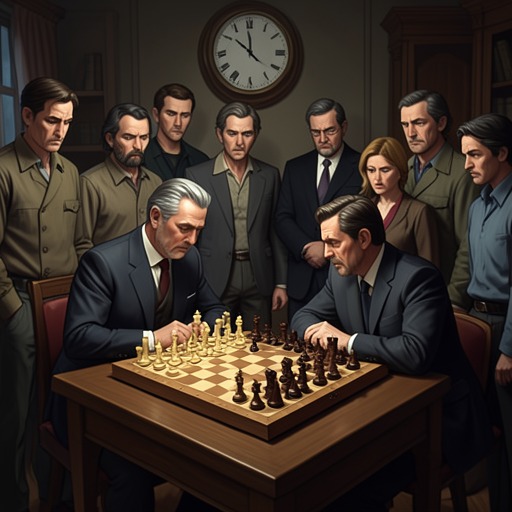
The match begins at three o’clock the following day, with two ship’s officers joining the spectators. The narrator presents the game as a confrontation between sharply contrasting ways of inhabiting chess. Czentovic remains nearly motionless, his attention fixed on the board; Dr B is relaxed, speaks during the intervals, and needs only a brief look at the position before moving. At first the moves come quickly. By the seventh or eighth move, Czentovic’s longer thought signals that the contest for advantage has begun.
For the spectators, however, the developing positions are difficult to interpret. Their attention is drawn as much to the players’ contrasting demeanors as to the strategy, and they later fail to reconstruct the game from memory. In this setting, the royal game is not simply a demonstration of skill. It becomes the means by which Dr B tests the boundary between the mental world that sustained him and the dangerous compulsion he fears repeating.